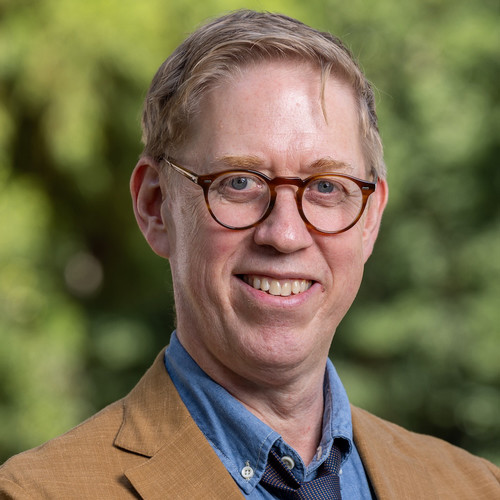
Eric SandayActing Professor
Education
PhD Philosophy, Pennsylvania State University, 2003
MA Philosophy, Fordham University, 1996
BA Physics, University of Physics, 1991
Research
My research and teaching are organized around a shared question: what does it mean to give an account? In ancient Greek philosophy, giving an account is not simply explaining what one already thinks. It is the work of becoming answerable — to reasons, to texts, to others, to civic life, and to the parts of experience that resist conceptual mastery.
Much of my work focuses on Plato, especially the late dialogues, where philosophical inquiry tests its own starting points. In my book, A Study of Dialectic in Plato’s Parmenides, I argue that the dialogue’s difficult hypotheses are not merely puzzles about abstract formal arguments, but exercises in philosophical thinking. The Parmenides teaches readers to hear a name or claim as an open question whose meaning must be recovered through inquiry rather than being stipulated in advance. That project continues in my work on the Statesman, Philebus, Laws, and Timaeus, where I examine how dialectic, law, pleasure, measure, political community, embodiment, and nature reveal the limits of any completed account.
A central theme of my research is that every account leaves something out. This remainder is not simply a failure of thought. In Plato, this failure is often the pressure that keeps inquiry alive and prevents philosophy, politics, or education from hardening into dogma. My current book project, The Counter-Logic of Life in Plato’s Timaeus, develops this theme by examining life, embodiment, and material necessity as dimensions of the world that submit to intelligible order while also resisting full conceptual closure. Related projects extend this work into Plato on eros and self-knowledge, Aristotle on imagination and ethical life, and Roman Stoicism on friendship, emotion, and political belonging.
My teaching is continuous with this research. I understand the classroom as a place where students practice what the ancient tradition calls logon didonai: giving an account. I call the central pedagogical habit active receptivity. By this I mean the disciplined openness required to let a text, an argument, or another person challenge one’s settled assumptions. Active receptivity is not passive absorption. It asks students to formulate claims, locate textual warrant, face objections, revise judgments, and take responsibility for what they say.
I design courses as graduated exercises in accountable inquiry. In my 200-level writing course, students learn the basic disciplines of philosophical reading and writing through ancient texts by Hesiod, Presocratic thinkers, Plato, Aristotle, Epictetus, and Seneca. The goal is to teach students that interpretation is not personal reaction but a disciplined response to what a text says, what it assumes, and what it leaves unresolved. In upper-level courses, students move from conceptual framing to analytical writing, oral interview, group enactment, peer review, and final oral defense. There, philosophical argument becomes public reasoning. In my graduate seminars, students become co-responsible for the inquiry itself by leading extended seminar discussions, writing prompt responses, developing paper projects, and generating the questions through which research can proceed.
Across these courses, my aim is the same: to help students become careful readers, responsible speakers, and independent thinkers who can remain open to what exceeds their first formulations. In that sense, the philosophical “what?” question is never merely abstract; pursued carefully, it opens onto the more personal “who?” question by asking each of us to become responsible for the standpoint from which we inquire. Philosophy begins, for me, in the encounter between conviction and what unsettles it. My work as a scholar and teacher is to sustain that encounter long enough for thought to become more truthful, more responsive, and more free.
Books
- A Study of Dialectic in Plato’s Parmenides. Northwestern University Press, 2015.
- Companion to Ancient Greek Philosophy. Co-edited with Sean D. Kirkland. Northwestern University Press, 2018.
- Plato’s Laws: Force and Truth in Politics. Co-edited with Greg Recco. Indiana University Press, 2013.
Publications
- “Signposts for the Study of Nature: Parmenides’ Fragment 8.” In Inquiring into Being: Essays on Parmenides, edited by Colin Smith, 179–206. State University of New York Press, 2025.
- “Plato’s Statesman and the Nature of Philosophical Writing.” Proceedings of the Boston Area Colloquium in Ancient Philosophy 37, edited by Gary M. Gurtler, S.J., and Daniel P. Maher, 111–158. Brill, 2023.
- “The Subject and Number of Hypotheses in Plato’s Parmenides.” In Plato’s Parmenides: Selected Papers from the Twelfth Symposium Platonicum, edited by Luc Brisson, Arnaud Macé, and Olivier Renaut, 309–316. Academia Verlag, 2022.
- “Wandering Motion in Plato’s Timaeus.” Chôra: Revue d’études anciennes et médiévales 20 (2022): 33–53.
- “Introduction.” With Sean Kirkland. In Companion to Ancient Greek Philosophy, edited by Sean Kirkland and Eric Sanday, ix–xix. Northwestern University Press, 2018.
- “Being in Late Plato.” In Companion to Ancient Greek Philosophy, edited by Sean Kirkland and Eric Sanday, 147–160. Northwestern University Press, 2018.
- “Self-Knowledge in Plato’s Symposium.” In Knowledge and Ignorance of Self in Platonic Philosophy, edited by Andy German and James M. Ambury, 186–205. Cambridge University Press, 2018.
- “Paradigm and Dialectical Inquiry in Plato’s Statesman.” In Plato’s Statesman: Dialectic, Myth, and Politics, edited by John Sallis, 149–170. State University of New York Press, 2017.
- “Truth and Pleasure in the Philebus.” Graduate Faculty Philosophy Journal 36, no. 2 (2015): 347–370.
- “Phantasia in De Anima.” In The Bloomsbury Companion to Aristotle, edited by Claudia Baracchi, 106–127. Bloomsbury, 2014.
- “Property and Impiety in Plato’s Laws: Books 11 and 12.” In Plato’s Laws: Force and Truth in Politics, edited by Greg Recco and Eric Sanday, 215–235. Indiana University Press, 2013.
- “Reply to Haydn Ausland.” Proceedings of the Boston Area Colloquium in Ancient Philosophy 28, edited by Gary M. Gurtler, S.J., and William Wians, 27–35. Brill, 2012.
- “Challenging the Established Order: Socrates’ Perversion of Callicles’ Position in Plato’s Gorgias.” Epoché 14, no. 2 (2012): 197–216.
- “Eleatic Metaphysics in Plato’s Parmenides: Zeno’s Puzzle of Plurality.” Journal of Speculative Philosophy 23, no. 3 (2009): 208–226.
- “Philosophy as the Practice of Musical Inheritance: Republic Book II.” Epoché 11, no. 2 (2007): 305–317.
Fellowships
- CELT Teaching Innovation Institute 2, University of Kentucky, 2023.
- Grant for Timaeus Workshop, University of Kentucky, 2019.
- Grant for Laws Workshop, University of Kentucky, 2008.